

What Is AI-Powered Client Onboarding?
AI-powered client onboarding uses a trained AI assistant to guide new clients through your setup process, answer their questions in real time, collect required information, and ensure nothing falls through the cracks. Instead of sending a PDF and hoping clients follow the steps, you give them an interactive guide that knows your entire process.
The assistant handles the repetitive parts (collecting information, explaining next steps, answering common questions) while you focus on the relationship-building parts that actually require a human touch.
For service businesses like agencies, consulting firms, and financial advisors, onboarding is where first impressions are made. 68% of clients say onboarding quality determines whether they stay long-term. Getting it right matters.
Why Is Manual Client Onboarding a Problem?
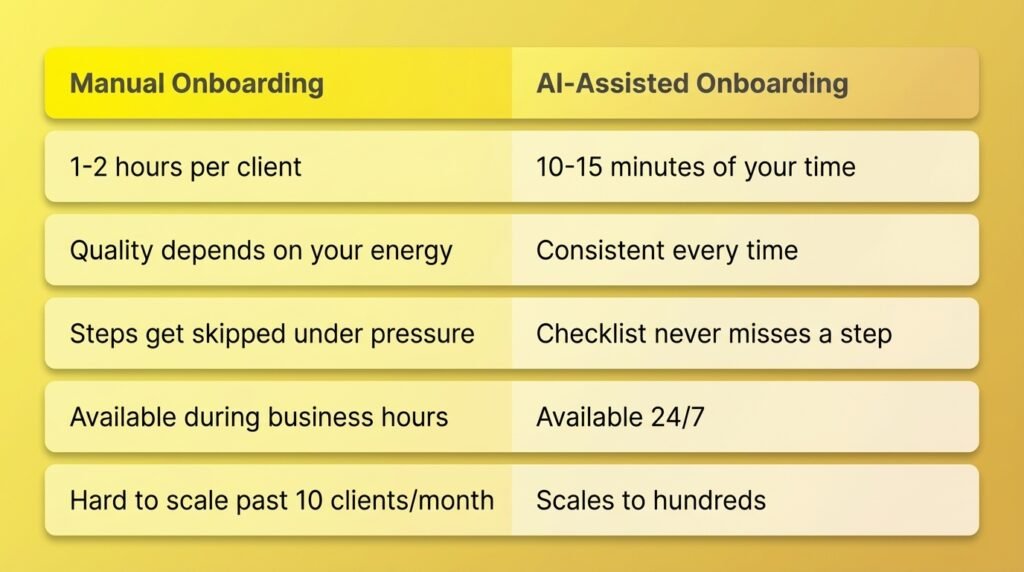
Manual onboarding creates three problems that get worse as your business grows.
Problem 1: It does not scale. If onboarding one client takes 2 hours of your time, onboarding 10 clients in a month costs you 20 hours. That is half a work week spent repeating the same explanations.
Problem 2: Quality varies. When you onboard a client at 9 AM after a good night’s sleep, they get your A-game. When you onboard someone at 4 PM on a Friday, they get a rushed version. AI delivers the same quality every time.
Problem 3: Things get missed. Without a structured process, important steps get skipped. Missing a compliance document, forgetting to collect a W-9, or not explaining your communication policy creates problems weeks later.
How Do You Build an AI Onboarding Assistant?
Building an AI onboarding assistant takes about 15 minutes on a no-code platform. Here is the step-by-step process.
Step 1: Document Your Current Onboarding Process (5 minutes)
Write down every step a new client goes through, from the moment they sign up to the moment they are fully set up. Include:
- What information you need to collect (name, business details, preferences)
- What documents or forms they need to complete
- What you need to explain (your process, timeline, communication preferences)
- What common questions clients ask during onboarding
Most businesses have 8 to 15 steps in their onboarding process. Write them all down, even the ones that seem obvious.
Step 2: Create Your Knowledge Base (5 minutes)
Upload the documents your onboarding assistant needs:
- Onboarding checklist with every step and requirement
- Welcome guide explaining your services and process
- FAQ document covering the questions new clients always ask
- Policy documents (communication expectations, billing, timelines)
- Setup instructions for any tools or portals clients need to access
Step 3: Write Onboarding-Specific Instructions (5 minutes)
Your AI assistant needs clear instructions for how to handle the onboarding conversation:
You are the onboarding coordinator for [Business Name]. You guide new clients through our setup process step by step.
Tasks: Walk clients through each onboarding step in order. Collect required information (name, business type, goals, preferences). Answer questions about our process using the knowledge base. Flag any issues that need human attention.
Boundaries: Never skip steps in the onboarding checklist. Never promise timelines shorter than what is in the process guide. If a client has a complex situation, collect their details and let them know a team member will follow up within 24 hours.
Tone: Welcoming and professional. Use the client’s name. Be patient with questions. Make them feel like a priority.
Step 4: Test the Full Onboarding Flow
Run through the entire onboarding process as if you were a new client. Check that:
- The assistant follows the correct sequence of steps
- Information collection is complete (nothing gets missed)
- Answers to common questions are accurate
- The tone feels warm and professional
- Edge cases are handled gracefully (incomplete information, unusual requests)
What Results Can You Expect From AI Onboarding?
Businesses that implement AI-assisted onboarding typically see improvements across three areas within the first month.
Time savings: The average service business saves 4 to 10 hours per week on onboarding tasks. For a solo consultant taking on 5 new clients per month, that is roughly 10 hours back.
Client satisfaction: Clients get immediate responses instead of waiting for your next available time slot. 85% of clients prefer instant, self-service onboarding over scheduling a call and waiting.
Completion rates: Structured AI onboarding reduces drop-off during the setup process. When clients can complete steps at their own pace with real-time guidance, more of them finish the full onboarding. Businesses report 20-30% higher completion rates compared to email-based onboarding.
What Industries Benefit Most From AI Onboarding?
AI onboarding works for any service business, but these industries see the fastest return on investment.
Financial advisory firms: Collect client financial profiles, explain fiduciary duties, gather required compliance documents, and walk clients through portal access. On governed platforms like LaunchLemonade, audit trails ensure every onboarding interaction is documented for compliance.
Consulting firms: Explain engagement scope, collect project requirements, set communication expectations, and guide clients through your methodology overview.
Marketing agencies: Gather brand guidelines, collect access credentials (with proper security), walk clients through your project management tools, and explain your review and approval process.
Accounting firms: Collect business information, explain document requirements for tax preparation, guide clients through your secure file-sharing portal, and answer questions about timelines and deliverables.
Real estate agents: Walk buyers or sellers through your process, collect preferences and requirements, explain market conditions, and set expectations for communication and timelines.
Frequently Asked Questions
How long does it take to set up an AI onboarding assistant?
On a no-code platform like **LaunchLemonade**, setup takes about **15 minutes**. Document your process, upload your onboarding materials, write instructions, and test. Most businesses spend another 30 minutes refining the assistant during the first week based on real client interactions.
Will clients know they are talking to an AI?
Yes, and that is fine. Be transparent. Most clients appreciate the immediate availability and consistent guidance. The key is making sure the AI experience is genuinely helpful, not a barrier. Always provide a clear path to reach a human team member when needed.
Can an AI onboarding assistant collect sensitive information?
It depends on the platform. Governed platforms like **LaunchLemonade** include data controls and encryption designed for businesses handling sensitive client information. Always verify that your platform meets your industry’s compliance requirements before collecting sensitive data through AI.
What if a client has a question the AI cannot answer?
A well-built onboarding assistant has a fallback rule: acknowledge the limitation, collect the client’s contact information, and promise a human follow-up within a specific timeframe. On platforms with audit trails, your team can see exactly what was asked and respond with full context.
Does AI onboarding replace the need for human interaction?
No. AI handles the repetitive, structured parts of onboarding (information collection, FAQs, step-by-step guidance). You still handle the relationship building, strategy discussions, and complex situations. The result is that your human interactions become more valuable because you spend them on high-impact conversations instead of paperwork.